
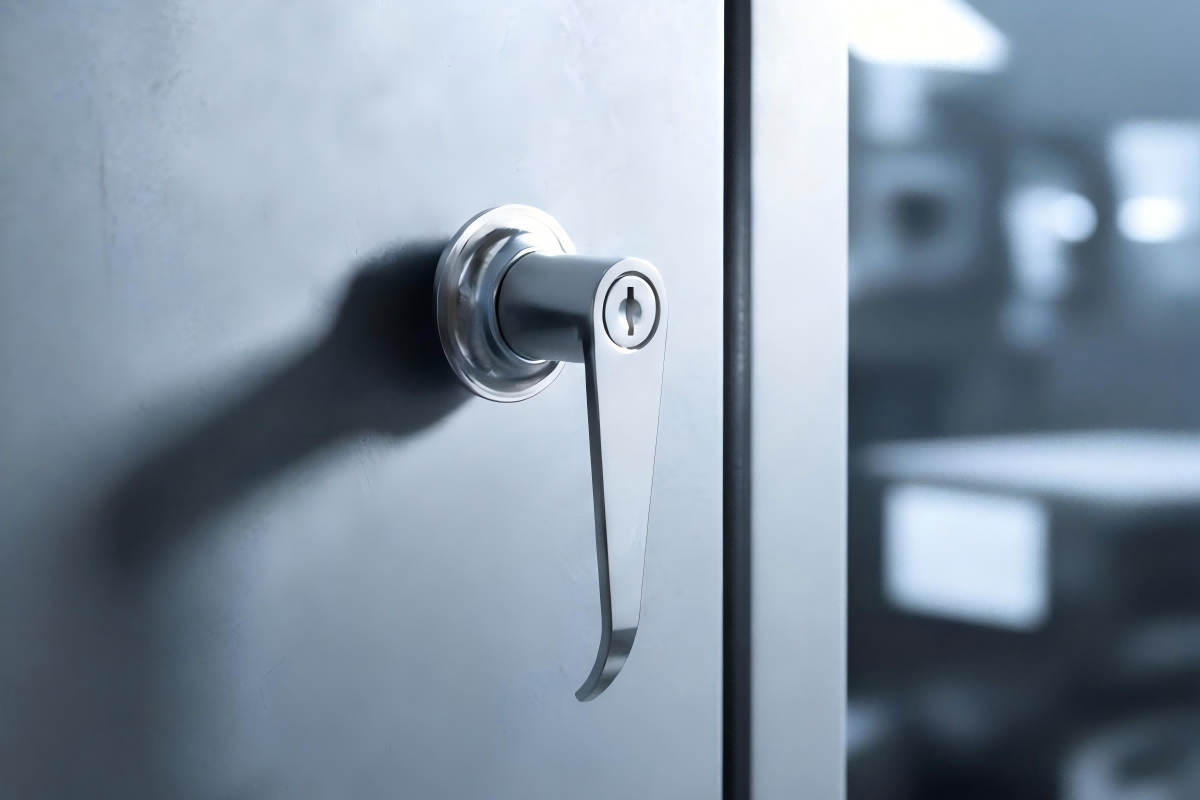
In the realm of industrial safety, electrical cabinets—the “heart” of power distribution—rely on their first line of physical defense: locks. These components play an irreplaceable and critical role. Despite the sweeping wave of digitization across industries, within power systems that demand extreme reliability, environmental resilience, and intrinsic safety, specialized, robust, and highly compatible mechanical locks have seen their core importance not diminished but rather amplified by rising technical standards. For enterprises in the locking industry, insights into the trends of this niche sector are key to consolidating market and technological leadership.
Trend 1: From General-Purpose to Specialized, Structural Innovation Drives Intrinsic Safety
The core principle of modern industrial safety is “prevention first.” Consequently, the primary evolution for electrical cabinet locks is to transcend simple “closing and locking.” Through precise mechanical design, they achieve deep interlocking with equipment operation logic, preventing human error at a fundamental level.
Traditional padlocks or simple door latches are no longer sufficient. Leading-edge designs now feature physical interlocking between the lock and critical components like circuit breaker handles, drawer unit mechanisms, and earthing switches. For instance, an innovative drawer unit interlock uses a gear-and-rack design to ensure a circuit breaker can only be closed once the drawer is fully and mechanically seated, entirely eliminating the risk of live connection/disconnection. In outdoor disconnect switchgear, new locking devices can precisely restrict the operating angle to a safe range, preventing overtravel and equipment damage. This trend of upgrading locks from “independent components” to “integrated safety modules” is the culmination of patented technology and deep industry understanding.
Trend 2: The Deep Evolution of Materials and Processes, Confronting Extreme Challenges
Electrical cabinets serve in vastly different environments—from clean indoor data centers to outdoor and industrial sites with corrosive atmospheres, salt spray, high humidity, or severe temperature swings. Thus, the materials science and surface finish technology of a lock have become hard metrics of its professionalism.
The industry is shifting from generic materials to more specialized solutions:
- Core Materials: High-quality zinc alloy die-castings are widely used for interior locks due to good strength and manufacturability. For harsh environments, 304 or even 316 stainless steel is becoming the首选 for outdoor, coastal, or chemical plant applications, its superior corrosion resistance ensuring long-term lock integrity.
- Surface Finishes: Simple painting is often inadequate. Professional electroplating (e.g., zinc-nickel alloy), Dacromet coating, and high-grade powder coating can provide thousands of hours of protection in neutral salt spray tests, ensuring the lock does not fail or become inoperable due to corrosion during its service life.
- Critical Components: The dust/water resistance rating of the cylinder, the fatigue resistance of springs, and the weather resistance of seals collectively form the foundation of lock reliability.
Trend 3: The Balancing Art of Standardized Compliance and Customized Demand
Global and national electrical safety standards (e.g., IEC, GB, UL) clearly specify requirements for cabinet protection (IP Code), mechanical strength (IK Code), and safety. Professional locks are not just part of the cabinet; they are key to meeting these standards. A lock must ensure the door achieves its rated IP rating when closed, and its structural strength must withstand a defined level of physical attack (IK rating).
Simultaneously, the demand for deep customization is growing. While standard products meet most needs, leading original equipment manufacturers (OEMs) increasingly require locks to integrate seamlessly with cabinet design language and brand identity in terms of dimensions, shape, color (RAL color matching), mounting style (recessed, surface-mounted, three-point), and even operational feel. Lock suppliers capable of offering services ranging from standard products to rapid custom development are gaining stronger customer loyalty and higher product value.
Industry Insights, Future Outlook, and the Lida Commitment
For companies focused on industrial locks, the electrical cabinet market is a prime stage to demonstrate professional capability. Future competitiveness will depend not only on manufacturing prowess but also on:
- Deep Industry Insight: A profound understanding of electrical equipment structure, operational workflows, and safety protocols, transitioning from a “lock manufacturer” to an “electrical safety physical solution provider.”
- Engineering Collaboration Capability: Engaging in front-end design collaboration with major cabinet OEMs, developing locks as an integral part of their products.
- Quality and Certification Systems: Establishing rigorous quality control and obtaining industry-recognized certifications (e.g., CE, UL, RoHS) are passports to the global supply chain.
In this wave of evolution, Lida Lock remains grounded in the fundamentals of the industry, focused on translating these trends into tangible, reliable product strength. We firmly believe that true safety begins at the most basic point of physical contact. Therefore, Lida not only supplies internationally compliant MS-series standard locks but is also committed to:
- Being a “Solution Partner” to Our Clients: We delve deep into the design needs of cabinet manufacturers and the operational scenarios of end-users, offering services from standard product selection and to fully customized interlock.
- Upholding a Manufacturing Philosophy of “Reliability Above All”: From the selection of high-purity zinc alloy materials to the parameter control of every plating and painting process, Lida has established a traceable quality, ensuring every lock that leaves our factory performs stably for years, even in demanding environments.
Looking ahead, Lida Lock will continue to apply professional craftsmanship to the niche field of industrial locks. We look forward to partnering with more excellent electrical equipment manufacturers and end-users to jointly safeguard the absolute reliability of the “final centimeter” in electrical safety. Let the steadfast metal form become the most fundamental bedrock of trust in the intelligent industrial world.
Choosing Lida is choosing a consistent and commitment to industrial safety.
Post time: Jan-12-2026